(This started out as a reply to Roger White’s post ‘Celebrating the UK: No. 3 in an occasional series – attitudes to immigration and diversity’. However, the reply would disappear without error message or any other feedback; as I (successfully) commented there in frustration, ‘between malice and incompetence—the weight of censorship imposed by SJWs and the poor code produced by diversity-hires—the internet becomes more unusable every day.’ Edited to be less direct and aimed at a general reader.)
nation › noun a large body of people united by common descent, history, culture, or language, inhabiting a particular state or territory: …[1]
This post will discomfort some as its content by modern standards is quite far to the Right*; but while leaning towards ‘14’[2] territory, I am not of the ‘88’ crowd, deeming admiration for Churchill intrinsic to being British†.[3]
(* Although the terms ‘Left’ and ‘Right’ mean little now; as conventionally liberal Roseanne Barr said: ‘I’m still the same, you all moved. You all went so f***ing far out you lost everybody.’ Even Attlee would be ‘no-platformed’ as a ‘fascist’ these days.)
(† Of course these days some call Churchill a ‘Nazi’. Sorta funny: mere weeks prior to that, I’d remarked that if we sent SJWs back in time to 1940, they’d be calling Churchill ‘Hitler’, FDR ‘Hitler’, everyone would be ‘Hitler’ except for the moustachioed bloke in Berlin—who, given their views on Israel, welfare, environment, etc. they might actually approve of.[4])
These are our islands. And we should not have to apologise or beg anyone’s pardon for stating that.
I do not advocate an ethnostate—but nor do I wish some multicultural mishmash, and I certainly do not want us replaced. Winston, as First Lord of the Admiralty, once wrote in a memo prohibiting racial discrimination in the navy: ‘I cannot see any objection to Indians serving on H.M. ships … or, if their virtues so deserve, rising to be Admirals of the Fleet. But not too many of them, please.’ Such is my view: I have no problem with people coming from anywhere, Best of British to them—but not too many of them, please. A few are interesting; too many, and we cease being British.
And we are indeed on our way to ceasing being British.[5] Our nation’s capital no longer majority British let alone Londoner; 26 local authorities in England so far recording <50% White British. It’s not just raw numbers one should look at (although they’re bad enough, White Britons being projected to be a minority by 2066) but the young who will inherit these islands for, as Mark Steyn writes, ‘The future belongs to those who show up for it.’ In England, Scotland and Wales, the number of pupils in schools recorded as ‘White British’ decrease every year, without fail—a consistent downward trend. In England, they have decreased >1% annually, from 75.6% in 2010 to 66.97% in 2018; Scotland has an average annual decrease of 0.63%, from 89.7% to 84.67% 2010–18; and in Wales, average annual decrease is 0.42%, from 91.84% to 88.47% 2210–18. Even if it doesn’t accelerate, White British pupils will go under 50% in England in 2034, barely 15 years away. As Douglas Murray writes (bold added):
[B]y the end of the lifespans of most people currently alive Europe will not be Europe and the peoples of Europe will have lost the only place in the world we had to call home.
(The Strange Death of Europe: Immigration, Identity, Islam. Bloomsbury, 2017. 1.)
These are our islands, and our islands are our home—the only one we have. Almost everyone else has a home to return to if they find life in Britain uncongenial. The Somalian has Somalia; the Nigerian, be he Muslim or Christian, has Nigeria; the Indian, Pakistani and Bangladeshi have their respective countries; Thais, Thailand; etc. But Britons have only Britain. Are we not permitted our own country? Or are we to be told, as one German politician (Walter Lübcke) informed the native Germans over whom he presided that if they didn’t like their government’s immigration policy, they were ‘free to leave’? (Some choice: accept becoming a minority in one’s own country, or leave and become a minority in someone else’s; still, these chaps would wholeheartedly agree with him.)
Here is a cartoon of a ‘nationalist’ world versus a ‘multicultural’ one—a modified version of this triteness. The first one, the modified one, reflects reality better. If I go to France, I want to meet French people, experience French culture, see French architecture, and prepare by taking a French phrasebook. If I go to China, I want to meet Chinese people, experience Chinese culture, see Chinese architecture, and prepare by taking a Chinese phrasebook. And the same for whatever country I decide to visit, long or short term. But if everywhere is multicultural, then everywhere is the same and there is no point in going anywhere or learning anything about anyone else. Regarding the latter sentiment, it is observable that most, if not all, multicultural virtue-signalling is entirely superficial; as Mark Steyn wrote:
Mr. Tayler [(1808–92)], a minor civil servant in Bengal, was a genuine “multiculturalist.” That’s to say, although he regarded his own culture as superior, he was engaged enough by the ways of others to study the differences between them. By contrast, contemporary multiculturalism absolves one from knowing anything about other cultures as long as one feels warm and fluffy toward them. After all, if it’s grossly judgmental to say one culture’s better than another, why bother learning about the differences? “Celebrate diversity” with a uniformity of ignorance. Had William Tayler been around when the Islamification of the West got under way and you’d said to him there was a mosque opening down the street, he’d have wanted to know: what kind of mosque? Who’s the imam? What branch of Islam? Old-school imperialists could never get away with the feel-good condescension of PC progressives.
(‘Celebrate tolerance, or you’re dead.’ Maclean’s, 28 Apr 2006.)
Look at immigration from, say, a Japanese point of view.
[Tangent starts…
And, btw, I hate not being able to simply put my own view as a straight, white male, but that is the modern West: where the innocuous slogan ‘It’s okay to be white’ has people ‘shocked and disturbed’ and ‘horrified’—not at the idea that Whites might have problems qua Whites but at the mere declaration that it is ‘okay to be white’—and police investigating. Thus, if arguing that men have problems, as men for being men, it’s best to have a woman (e.g. Karen Straughan or Cassie Jaye) at the forefront, because arguing as a man will lead to such as Jess Philips refusing to allow even a single day for discussion, laughing at the mere idea; and if not a woman, then a practicing homosexual such as Milo Yiannopoulos or blacks such as Larry Elder and Thomas Sowell.
Because we are deemed ‘privileged’—even the homeless guy sleeping on a park bench (I kid you not). ‘Privileged’. So ‘privileged’ that when a non-Straight White Male assaults a woman, two (apparently) Straight White Males deciding that ‘discretion is the better part of valour’ are the ones who the victim condemns, not her actual attacker who she sympathises with, describing him as ‘obviously need[ing] help’. (Possibly the men were tired of being constantly demonised; or, being ‘in their fifties’ (i.e. past ‘military age’), that it would not be sensible to mix it up with a lunatic of 30–35 (i.e. ‘military age’), especially as we have been disarmed (in significant part by guess who?), and the law is oft ambiguous about whose side it’s actually on.)
Cecil Rhodes once advised a young officer off to police a bit of Empire: ‘Remember that you are an Englishman, and have consequently won first prize in the lottery of life.’ That ‘first prize’ for many was climbing out of the trenches at the Somme (57,470 casualties on its first day), or drowning in the mud of Passchendaele. While Rhodes did not foresee the slaughter of WW1, even in his lifetime (1853–1902) many an Englishman’s ‘first prize’ was only ‘some corner of a foreign field … for ever England’—as illustrated by Kipling’s 1886 poem ‘Arithmetic on the Frontier’: ‘Two thousand pounds of education / Drops to a ten-rupee jezail.’ We weren’t even ‘privileged’ back then; and things have got a whole helluva lot worse since.
…Tangent ends]
Anyway, look at immigration from a Japanese POV.
So, I was looking at traditional Japanese architecture and décor, and started daydreaming about emigrating there and immersing myself in their culture. If only my life had taken different turns, if I’d gone there, found myself a waifu—bought a traditional Japanese home, decorated it with traditional Japanese décor, lived in traditional Japanese style; tried to be more Japanese than the Japanese. Then I thought: it wouldn’t matter how hard I tried to be ‘Japanese’, I would never be anything other than the funny gaijin, some odd Brit pretending to be Japanese; they might regard me with genuine affection but there would always be a slight barrier—gauche mistakes in speech or habit because it was not a culture I was born to. My children would have a better time of it: born and raised there and ethnically half-Japanese; my three-quarters Japanese grandchildren would be almost indistinguishable from their fellow Japanese; my great-grandchildren completely indistinguishable (maybe one would have blue eyes, another a slight height advantage); a generation or two after that, someone would test their DNA to see if they had any Chinese or Korean blood and be surprised to learn they had a trace of European—and blame it on the long American presence rather than a forgotten eccentric Brit. It would be as if I’d never even went—but would my hypothetical Nipponophile self mind? And from the Japanese perspective, this could not be better: they would have taken in a Caucasian, saw him breed with a native, and still completely absorbed him and his progeny, both ethnically and culturally. Japan would continue being Japanese. And that’s a good thing! Unless wanting to make a case for the ethnic and cultural eradication of Japan?
Similarly, we too can absorb people,[6] even from radically different cultures and ethnicities—but only if they arrive in sufficiently small numbers. But the levels of migration we are currently asked to tolerate are historically unprecedented, ‘a demographic change not just unprecedented in British history, but in almost any country that has not suffered catastrophic military defeat’ (West, Ed. The Diversity Illusion: What We Got Wrong About Immigration and How to Set it Right. Gibson Square, 2013. 16.):
Throughout most of its history, and certainly for the previous millennium, Britain had retained an extraordinarily static population. Even the Norman Conquest in 1066—perhaps the most important event in the islands’ story—led to no more than 5 per cent of the population of England being Norman. What movement there was in the years before and after was almost entirely movement between the island of Ireland and the countries that would eventually comprise the United Kingdom.
…
And although there was often a trickle of people moving in, the mass movement of people was almost unknown. In fact immigration was so unknown that when it did happen people talked about it for centuries. When discussing migration into the United Kingdom today one can expect someone to mention the Huguenots—those Protestants forced to flee persecution in France to whom Charles II offered sanctuary in 1681. The Huguenot example is more resonant than people realise. Firstly, because despite the proximity of culture and religion enjoyed by French and English Protestants of the time, it took centuries for the Huguenots to integrate into Britain, with many people still describing themselves as coming from Huguenot stock. But the other salient point about the Huguenots … is the matter of scale. It is believed that up to 50,000 Huguenots arrived in Britain after 1681, which was undoubtedly a huge movement for the time. But this scale was in a wholly different league to the mass immigration Britain has seen in recent years. From the period of the Blair government onwards Britain has seen an equal number of immigrants to that one-off number of Huguenots arriving not once in the nation’s history, but every couple of months. … Another example often given to defend the ‘nation of immigrants’ story is that of the 30,000 Ugandan Asians who were brought into Britain in the early 1970s after Idi Amin expelled them from Uganda. In the UK memories of this one-off influx are generally coloured with pride and good feeling, not just because it was a demonstrable and limited relief of a desperate people, but because those Ugandan Asians who arrived in Britain often made a palpable and grateful contribution to public life. In the post-1997 years of immigration the same number of people as that one-off 30,000-strong influx arrived into the country every six weeks.
(Murray, Douglas. The Strange Death of Europe: Immigration, Identity, Islam. Bloomsbury, 2017. 13,30–31.)
50,000 Huguenots, and we still talk about them; 30,000 Ugandan Asians, and we still talk about them. Last year, ‘602,000 people moved to the UK’ according to official figures, which excludes illegal immigrants, obviously difficult to measure but the Times reported Home Office estimates of ‘up to 250,000 people a year’ in 2017.
We need a pause: a moratorium on immigration to allow us to sort this problem out; to integrate those already here legally, and to identify and eject those here illegally and those not contributing to the commonweal.
And the solution to a ‘static or declining population’ is to (1) determine if that is not actually a desideratum,[7] and (2) if confirmed not, address why the native population is not reproducing at least replacement rate; similarly, rectifying any shortfalls in native skills is what is needed, not throwing our insufficiently skilled neighbours onto the scrapheap. Importing replacements is avoiding issues not resolving them, while simultaneously creating other problems:
Diversity seems to trigger not in-group/out-group division, but anomie or social isolation. In colloquial language, people living in ethnically diverse settings appear to ‘hunker down’—that is, to pull in like a turtle. … [A] wide array of other measures of social capital and civic engagement are also negatively correlated with ethnic diversity. In areas of greater diversity, our respondents demonstrate:
• Lower confidence in local government, local leaders and the local news media.
• Lower political efficacy—that is, confidence in their own influence.
• Lower frequency of registering to vote, but more interest and knowledge about politics and more participation in protest marches and social reform groups.
[Figure 6 omitted]
• Less expectation that others will cooperate to solve dilemmas of collective action (e.g., voluntary conservation to ease a water or energy shortage).
• Less likelihood of working on a community project.
• Lower likelihood of giving to charity or volunteering.
• Fewer close friends and confidants.
• Less happiness and lower perceived quality of life.
(Putnam, R.D. (2007) E Pluribus Unum: Diversity and Community in the Twenty-first Century. The 2006 Johan Skytte Prize Lecture. Scandinavian Political Studies, 30(2), 137–174.)
These are our islands, our home; and we have every right to deny entrance to strangers; to be choosy whom we accept as guests and to eject strangers who prove themselves unwelcome.

Scientists from Oxford University recently studied[8] the genetic make up of modern Britons and were amazed to find that they still live in the same broad tribal groupings as their ancestors almost 1,500 years ago. … What it shows about the UK population is that many local communities have stayed put for almost 1,500 years—many for far longer—and that their strong sense of regional identity with their birthplace is deep in their DNA. … Anglo-Saxon invaders tended to intermarry with, rather than replace the existing population. … There is also little Roman DNA in the British genetic make-up.
(Rimmer, Sandra. ‘Maps of Britain and Ireland’s ancient tribes, kingdoms and DNA.’ Abroad in the Yard. [Link added])
Note the map here, comparing the British Isles c.600 AD with Oxford University’s map plotting 17 distinct genetic groups found in British DNA, and how the genetic groups correlate with the tribal kingdoms; a millennium and a half later we are still the same people.
These are our islands.
Some of us have roots going back centuries, some of us millennia. Some of us can boast generations of loyal service to our nation. Some of us can point to photographs, framed on walls and in albums, of young men in uniforms changing through the decades: sepia photographs of great-grandfathers posing stiffly in WW1 Service Dress; black and white more informal photos of grandfathers in WW2 battledress; black and white then giving way to colour images of fathers in Malaya-, Aden- or early NI-green; and some of us can pull out pics of ourselves wearing DPM, Desert Cam or MTP. Some of us grew up contemplating photographs of ever young faces of men who never made it back—deprived of growing old ‘as we that are left grow old’; who gave their tomorrow for our today. Some of us watched our grandfathers brush a tear from his eye as he remembered his brother or best mate who never made it home.
These are our islands.
Every stone steeped in our history, every speck of earth steeped in our blood. If that ‘corner of a foreign field’ conceals ‘richer dust’ making it ‘for ever England’, how much ‘richer dust’ do our fields across our British Isles conceal? And how much more does it make our Isles ‘for ever England’?
Here is an interactive map of historical battlefields on the British mainland; here is another such site; and a page here. Take a moment to explore those maps; contemplate some few of the forgotten corners of our British Isles whose earth soaked up so much British blood—ancient Britons fighting Roman invaders, then Saxon then Norman; Anglo–Scottish wars and Plantagenet dynastic struggles, between peoples speaking the same language, worshipping the same God, and mostly descended from the original inhabitants of our isles. So, e.g. the Battle of Auldearn, just one more episode in the Civil War: Scottish and Irish Royalists under the Marquess of Montrose fighting against Scottish Covenanters of the Scottish Parliament. The Battlefields Trust records around 200 Royalists and 500 Covenanters left behind on that Nairnshire field. Whatever the rights and wrongs of that bitter conflict, which that day left over 700 Scots and Irish dead, their dust to mix with that rich British earth—it was our conflict; fought on our isles; one more chapter in our island story; our history.
These are OUR islands.
Our island story was written, to borrow the Great Man’s words,[9] in the blood, toil, tears and sweat of our ancestors.
Our ancestors.
Our blood.
Our toil.
Our tears.
Our sweat.
These… are… OUR… islands.
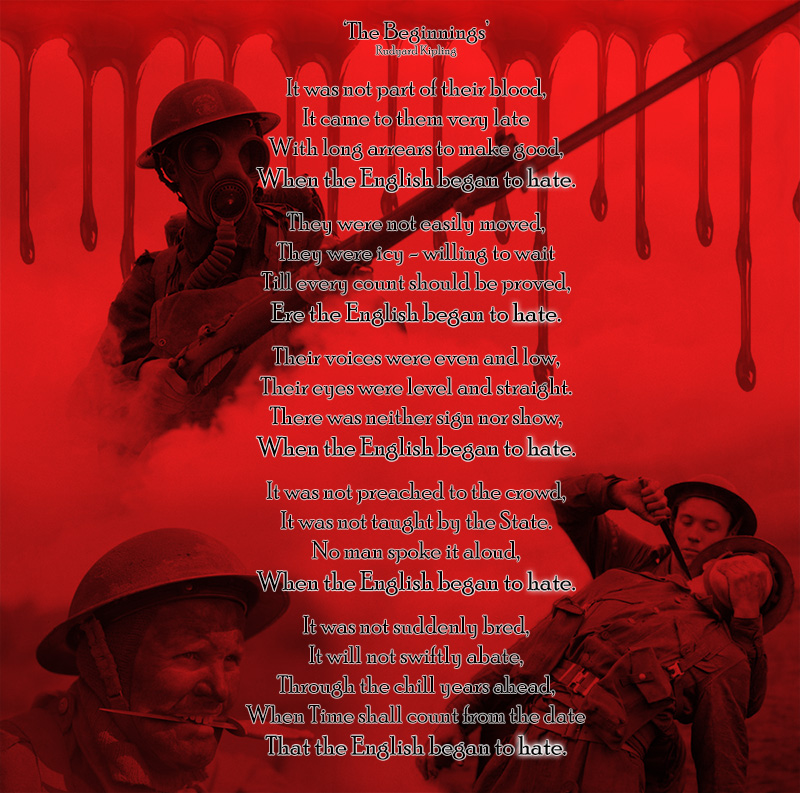
We fought, bled and died for them through the centuries. And it is not for anyone else to give away what we purchased with the blood and treasure of generations; what some of us swore an oath ‘by Almighty God’ on the Holy King James Bible to Her Britannic Majesty to defend.
+ + + + + + + + + +
Endnotes
[1] “Nation.” Oxford Dictionary of English, 3rd ed., Oxford University Press, 2010, p.1181. “Definition of nation in English.” Lexico, Oxford University Press.
[2] ‘We must secure the existence of our people and a future for white children.’
[3] As Douglas Murray perceptively remarked in a recent debate:
There was a straightforward answer to the question posed, ‘Why did the British people vote Churchill as being the greatest living or the greatest Briton ever?’, and you said, ‘—in spite of the 1910 Tonypandy and so on—some miners in 1910… Now, how could they have voted for Briton being the greatest?—and there are other versions—he drank too much—but there’s endless versions, and you think: so how could they have voted for him being the greatest Briton? And the answer is: because he saved Civilisation. And that ought to count in the class bit, it ought to count for something in history. But here’s the thing, if I may say so: the attack on Churchill has two things that are interesting to me. The first is local, the other is more general. The local one is this. There is an attempt to do this because, I think, there is a sense that at the deep root of British identity is a veneration for Churchill, and that if you could get Churchill, you can get the patriots and if you can get the patriots, then we wouldn’t vote Brexit, for instance.
And I just want to say something on that, because I think it’s so easy to take that bit for granted and, as Margaret Thatcher said in an interview in Sweden in the 1990s: if every country had taken Sweden’s attitude in the 1940s then Hitler would have won. And that isn’t nothing, and it’s got to count as something in the great log of human achievement: to have stood alone and to have saved Civilisation at that moment.
But the real thing I wanted to mention about this is something underneath that. There’s an extraordinary essay from Hannah Arendt from 1954* on the nature of action in a society and she says, the thing we’ve always had a problem with as human beings is we don’t know the consequences of acting in the world. It’s always been filled with terror for us, because we have no way of undoing action. So what’s the one mechanism we’ve ever come up with as a species? Forgiveness. Fast forward to the 2010s. The impossibility of acting in the world is worse than it’s ever been because a young person can wear the ‘wrong’ dress, photograph themselves, put it out on Twitter thinking they’re gonna get compliments and they are destroyed.
So we are in a world where acting in the world is worse than ever and nobody spends any time thinking about forgiveness—none. I can’t get anyone interested in the subject. So why don’t we work on mechanisms for getting out of this?
But, so, just to return to this: the reason why the Churchill one is so enervating for Society to hear is, people think then, Surely to have been the one leader in the world standing against Hitler at that moment ought to count for something? but it turns out if you did one thing wrong in 1910, it counts for nothing; and then people think in that case, in that—[interruption from audience, ‘Not one’†] okay, and you can have other criticisms—my point is that then people look at this and they think: I just can do nothing in the world in terms of action because nothing I will ever do could even remotely get to that so why bother?
(Alpine Fellowship. (2019, August 26) ‘The challenge of identifying’ Douglas Murray, Damian Le Bas, Maajid Nawaz, chair: Iain Martin.)
(* The Human Condition (1958; 2nd ed. 1998))
(† Audience member replies, demanding a ‘good mythology instead of taking these tawdry characters’, prompting Douglas’s nonplussed response: ‘Churchill—Churchill “tawdry”? “Tawdry”? Whew.’ On being asked who he would prefer to be held up as a hero, the audience member replied, ‘Alan Turing’—a man convicted for a sexual relationship with an unemployed man 20 years his junior whom he picked up in the street and who included burglars in his acquaintances.)
[4] Lips, L. (2018, November 2) Labour Blog Publishes Half of Hitler’s Manifesto. Harry’s Place. Archive of Labour Hub article, and the NSDAP’s 25-point Plan (25-Punkte-Programm) for comparison.
[5] E.g.
• Arkell, H. (2014, March 24) School where all pupils will be taught English as a foreign language: And that includes the ones who ARE English. Mail Online.
• Reid, S. (2016, November 2) ‘Go away, you shouldn’t be here. Don’t come back’: The corner of Yorkshire that has almost no white residents. Daily Mail.
• Stroud, C. (2017, August 18) ‘NO WHITES ALLOWED AFTER 8PM’ Shocking racist graffiti appears in Birmingham on wall in largely Asian inner-city neighbourhood.
• Watson, P.J. (2019, August 21) Pakistani Actress Visits UK Town, Says “It’s Like Being at Home”. Summit News.
[6] Further detail: ‘Discovering my ancestor, the runaway slave who became a Waterloo hero’, findmypast, 20 Oct 2015; ‘George Rose, The Escaped Slave Who Became A Waterloo Hero’, findmypast, 18 Jun 2015.
[7] E.g.
• Ford, Martin. Rise of the Robots: Technology and the Threat of a Jobless Future. Basic Books, 2015.
• Thomson, D. (2015, July/August) A World Without Work. Atlantic.
• Shell, E.R. (2018, November 20) AI and Automation Will Replace Most Human Workers Because They Don’t Have to Be Perfect—Just Better Than You. Newsweek.
[8] Leslie, S. et al. (2015) The fine-scale genetic structure of the British population. Nature, 519, 309–314. doi:10.1038/nature14230. (Abstract only)
[9] From Winston Churchill’s first Speech as Prime Minister. House of Commons. (1940). May 13 Debate (vol 30). Retrieved from http://bit.ly/2QxcnDh
Read follow-up comments…
Update #1: 23rd June 2019.
Unpublished reply to here:
…But where, when, and why do you disagree? This is an important topic, well worthy of discussion; so let’s discuss, either here or ‘my’ site. You disagree with the long post (now online, link in my second comment)? I know you will but what are your actual rebuttals to it? Can’t just dismiss 3,125 words (with 54 links—most not that important but context will identify those that are—two books, two academic articles and one op-ed) by simply stating that you ‘disagree with them’. Or my comments here? First one hardly counts, that was halfway to being a joke (well, I was amused); second one (a bit barbed but I was frustrated after yet another disappearing feedback-free comment) then?
In addition to govt. stats already linked, HMG helpfully publishes babies’ Christian names, blithely claiming ‘Oliver remained the most popular first name given to baby boys in England and Wales in 2017’, ignoring identical names spelled differently, especially when coming from languages with different alphabets and from corners of the world where illiteracy is prevalent. Thus, adding all recognisable spelling variants of ‘Mohammed’ (even excluding hyphenated variations of the variant spellings and the Turkish equivalent, ‘Mehmet’), shows that ‘Mohammed’ is actually the most popular boys’ name in England & Wales, and has been since 2011 (first reaching the top 10 in 2001 and hitting first place in 2009, but briefly dropping to 2nd in 2010). Unless people start taking this matter seriously, we and our children will find ourselves a minority within our own country within our lifetimes. This would not matter so much if they were assimilating—if they were walking our streets in bowler hats, pinstriped trousers and carrying furled umbrellas, looking like they stepped out of a Python accountant sketch but for darker complexions; but they’re not. Far from it.
‘Houston, we have a problem.’
And my question is valid: What is so special about ‘diversity’? If you had written, ‘we are becoming more positive about eating fruit,’ and I challenged, ‘What is so special about eating fruit?’ you would have little difficulty replying: informing me of the vitamins fruit contain, and the importance of those vitamins to our health; the pleasantness of their taste, along with the variety (diversity!) of different flavours allowing us to choose between sweet and tart as our tastes dictated. So if ‘diversity’ is such a boon, you should have just as little difficulty in describing its benefits.
*
Update #2: 23rd June 2019.
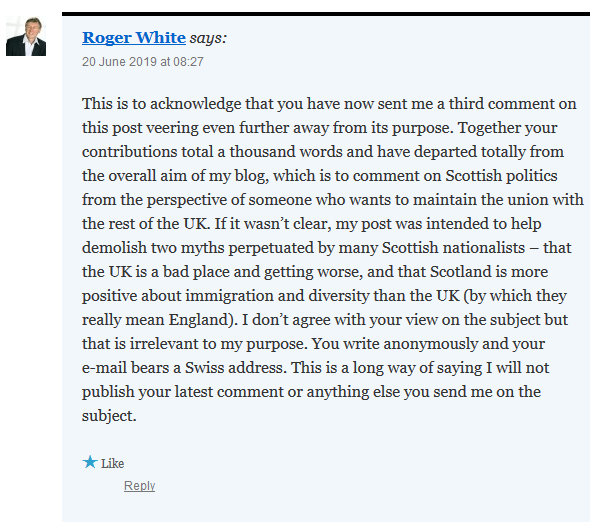
And Woger doth reply:
My response:
It’s a long way of saying, Runaway! Just like an SJW.
Of course I write pseudonymously (learn English, dipstick); maybe you haven’t been keeping up on current events but people get arrested in your Politically Correct dystopia for disagreeing with Establishment opinion.
Oh, so brave, agreeing with the Establishment. So bold, promoting the Establishment’s agenda.
When disagreement reared its ugly head, he bravely turned his tail and fled.
Yes, brave Sir Woger turned about
And gallantly he chickened out, bravely taking to his feet.
He beat a very brave retreat.
Bravest of the brave, Sir Woger.
You. Are. Pathetic.
Well, I’ll leave you to your virtue-signalling echo-chamber and your religion of diverssssiidddeeeee.
 A Deo rex, a rege lex.


